


I’d like to share a thought with you:
In order for something to be simple enough to be profound, it needs to first become complex enough to allow for a depth of understanding to be refined…
This thought has been pretty central to my qigong practice, and it has proven to be deeply influential in the way I share Qigong with others, but it’s not as straightforward as it may seem.
Striking a balance between refined understanding and disguised ignorance continues to be challenging, but it remains hugely important to me personally. In this article I’d like to explore the role of simplicity in teaching, personal practice and interacting with others.
Simplicity in Teaching
It’s fair to say that I’ve been very fortunate in my time as a Qigong Practitioner and Teacher. While I’ve been able to embrace the traditional approaches to teaching, I’ve also been able to take advantage of a range of opportunities to work in the corporate world, the academic sector and the integrative health space.
Working successfully in these spaces requires a different approach to qigong. In the traditional approach to teaching there is an acceptance that the people who come to your classes or workshop will be interested in Qigong, you are expected to occupy a position of knowledge and there is an unspoken sense of having to exhibit your level of gongfu in order to impose hierarchy. In these other spaces it is highly unlikely that you will find someone who will have even heard of Qigong let alone be interested in it, any knowledge you have is irrelevant and your level of gongfu is of no consequence.
As such, it becomes important to establish an understanding of the benefit of Qigong for the sector that you’re working in. Experience has shown that pre-planning what that benefit is, more often than not turns into an imposition of your judgement on a situation… Needless to say, it rarely works out that well.
What does work well is starting the session with a conversation that focuses on stripping things back to a common understanding of needs and requirements. This return to a simple, shared understanding creates a base from which to work. We are able to recognise the need, understand the language that the clients use and create a starting point from which we can build.
The process of returning to simplicity in this scenario opens up a lot of potential. It provides a point we can return to as a place to test the effectiveness of the technique in relation to the clients’ needs and requirements. A place from which to explore different perspectives and understandings with a clear understanding of common aims and objectives. And an experience of connection and mutual support that strengthens potential for change.
To me, this embracing of simplicity also feels far more coherent when we consider Qigong to be an awareness practice that helps us to become more skillful with our qi.
Simplicity and Wuji
While my understanding of simplicity in teaching came about through trial and error (which appears to be my default learning mode), it is actually present when we explore core concepts within Daoist philosophy and Qigong. Strangely, one of the first models I explored on my Qigong journey seems to hold the greatest wisdom in this area. This model is the Taijitu that includes Wuji as a red circle at the top of the diagram.
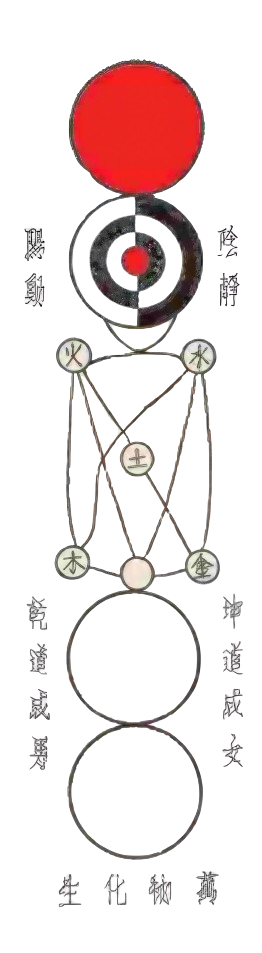
Figure 1. TheTaijitu
Reading this Taijitu from the top, Wuji can be viewed as the ultimate representation of simplicity, being a state in which anything is possible, yet nothing has arisen. The next level (the black and white circles with the red centre) is the first point of difference, the separation of Yin and Yang and the first point of both judgement and analysis.
From here, we move into a representation of the Five Elements in which we can see the interrelationship between both Yin and Yang and the Elements. Without wanting to dive into the details here, we can view this as a more complex (and possibly more useful) model that helps to analyse and understand.
Moving down again we find the myriad things (the two circles ontop of each other), which we can relate to the complex interplay of interacting factors that is part of the human experience and, arguably, increasingly complex in modern society.
Working from the top down, we find greater degrees of complexity being expressed, but my sense of this increasing complexity is that it is a framework that helps us to understand better the key aspect, being Wuji. In essence, a wonderful reminder that complexity is required so that we can find our way back to simplicity.
Simplicity in Learning
With the idea of finding a simple point from which to start when teaching and combining this with the implications of complexity being a fundamental aspect in refining understanding, I’d like to take a moment to explore an idea about learning.
When training Qigong teachers, we often discuss the nature of learning spaces: that is to say the creation of a space in which authentic learning can occur. This often feels at odds with our idea of education as we tend to have been conditioned to start learning by remembering as much as possible.
The idea of learning here is more about making sense of an idea or experience so that it can become our own understanding as opposed to a regurgitation of somebody else’s perspective.
This type of learning requires us to create space for fresh perspectives so that we can both absorb them and consider them. If we refer this back to the Taijitu, you can certainly draw parallels with the idea of Wuji representing a simple space from which we can both expand out from and return to. This is the process that was referred to at the beginning of this piece when I suggested that things need to become complex before they become simple.
So what?
Certainly from a qigong perspective, there are those who hoard theory and collect techniques in order to vomit them over anyone who is willing to stop long enough to be impressed by their apparent wisdom, but this is not really the true nature of the practice.
In order to be skillful with our qi, we need to have space in which to listen, we need the space in which to assess and grow, to adapt and evolve. This is as true in the application of the practice to everyday life as it is when sharing it with others. It requires us to stop making things complicated, this means we need to drop the judgement and the internal noise, step back, and take a moment.
My sense here is that this particular skill is not just relevant to Qigong. It is true in nearly all situations. So, I would like to finish this piece by asking the question:
Can you take a moment to quieten things down, to listen and embrace the simple in all its elegance and with all its vast potential?